Saturday, April 22, 2006

DISCOVERY!

Once in a while you come across an exhilarating story based on a new discovery… After teaching World War I and talking about militarism and the build up of new weapons including submarines, the advance in U-boats, their strategic use, their advantages over other crafts, etc. I stumbled upon a SPIEGEL ONLINE article entitled “The Secret of the Pearl Island” where Jim Delgado has made a great discovery while on vacation!

This is a cool story! Finds like this is what makes history such a great subject…! It is like finding Antonio Vivaldi’s music in a hidden drawer in an old school piece of furniture, or discovering a George Washington letter at a garage sale in Philadelphia – you get the idea…

Spiegel

Thursday, April 20, 2006

NATIONAL EDUCATION COMPUTING CONFERENCE

San Diego in the summer – what a wonderful vacation spot for those traveling out of state! For us that live in the area, it is always a treat and prices remind us of the cost of living in paradise! This is an amazing place.

We are lucky to be hosting the National Educational Computing Conference this July 5-7

Click on the image above to see the details of the conference.

There will be people from all over the United States coming for the conference and I am sure also a nice vacation. There will be many bi-lingual teachers attending and teachers from other parts of the world that speak Spanish.

I was encouraged to teach a workshop in Spanish about the use of technology in the classroom to teach history. Well, under the encouragement of a professor, I did so and submitted a proposal to the NECC.

It got accepted! So those of us that might be coming to NECC stop by and/or look me up in the program…

......Title: El Uso de Tecnologîa en la Enseñanza de la Historia
......Category: Concurrent
......Status: ACCEPTED

Friday, April 14, 2006

WRITER SEMINAR

It was a very interesting experience –

Having never participated in a writer’s workshop, a bilingual workshop none-the-less, the whole thing proved to be an exiting experience. The leader is a professional writer – and well trained in her craft. She shared some of her pointers…Here are some of them:

Write from the heart…
Be authentic…
Writing is transparent...
Respect your reader...
Mind the details...
Let it cool...
Writing is rewriting...
Don’t think...
Write!

There is also chemistry with the group that is fascinating – a Peruvian, a Mexican, a Puerto Rican and a Bolivian sitting with a Mexican-American creating and fine-tuning our journals. These are great folks – one is an accomplished poet, the rest including me are neophytes but with lots of “ganas”

The use of Spanglish is very interesting…. I have always held the purist opinion that you write in English or Spanish… honoring each language and not mixing the two except in extraordinary circumstances… but not here! I have to laugh…. mixing of the two languages is reminiscent of hearing “pocho-speak” – like our playful Latino College of Education professor who puts on his “pocho” hat and accent and has us in stitches! Even the title of the seminar is called “los bilingual writers” with a mirror image of the “bilingual” in Spanish…take a gander:

Very creative – don’t you think? Am I coming back? You bet – the writing combined with the great interaction with the participants turned the time into an interesting and productive evening…

Well, bueno pues, que nos queda… bye Vato!
If you care to participate contact Irene A. Márquez at (619)384-7144

Monday, April 03, 2006

EDUCATIONAL CONNECTIONS

This is highly recommended... a great teaching moment:


Friday, March 31, 2006

INTERESTING TIMES

I could not teach my last class… The class had to be re-scheduled for April. Very disappointing.

Why was school closed? Vista was closed because students walked out of class. Why did they do that? Students were protesting. What were they protesting? They were protesting new immigration laws.

As a history student - this is fascinating and without precedent. These are Latino students 13-18 years of age causing High Schools and Middle Schools to shut down in Vista, Oceanside and other cities in San Diego. The demonstrations have been for the most part peaceful (Thank God!) but revealing at the same time. With a bit of luck they will not become pawns of any political demagogue.

Hopefully there will be a realization of the cost.... to the student themselves, to parents, to the community, to the school, etc. Lesson #1: there is never a free lunch - someone will pay.

Oh boy, we live in interesting times.

Is this a tocsin of the things to come? What do you think?

Friday, March 24, 2006

STOKED!

I wanted to catch up… its been a while since my last update, no I have not given up or anything like that… I have been so extremely busy that it has been near impossible to focus on the blog – but it keeps calling me… so here is a quick update.

The spring semester started in late January, on time and on schedule except without me… I had to drop three out of five of my COE classes because of conflicts with my work – Was I disappointed? Very… but I am confident that it is the right thing to do for my work, for myself, and for my family. Well at least I was able to continue with two classes: my Beginning Student teaching and also the BCLAD class. One is behind me now (or almost) and the BCLAD class is on Saturday’s so I have no conflicts.

The Beginning student teaching was a blast! It started with a challenge in logistics, and the school bureaucracy but it smoothed out to a great teaching experience. Teaching 31 10th graders European History all in Spanish proved to be a challenge… I had to prepare the lessons from scratch – no textbook…don’t ask why.

I integrated key pedagogical strategies to engage the students achieving for the most part good outcomes. I introduced power-point lectures (never used in the classroom); we did word wall exercises, cartoon analysis, group presentations, etc. The class was supposedly the worst class in the teacher’s roster. Only 3-4 students were passing the class. I am not sure if in the four weeks I taught were sufficient to turn around the kids, but at least in the unit I taught (WWI) 14 students passed… the disappointment was in the fact that still I had 16 kids that did not do well… I was asked if I thought they could make it eventually - the answer is YES! I truly believe that these students could succeed.

The classroom experience gave me a lot to think about – but of all the things to think about, it certainly confirmed that I liked to teach and seemed able to connect with the students…

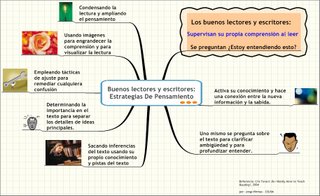
Here is an example of a mindmap about history – we used this at the beginning of the class…

I will use the expression I heard in school, it reflects how I feel about this teaching experience: “I am stoked!”

Friday, December 30, 2005

While cruising for preservice teacher information I came across this cool site from the DOE (Department of Energy) for Preservice jobs for Math and Science teachers… They pay you while you work with scientists….! Not a bad deal to get the real deal.

This is truly a pregnant site! Enjoy.

Thursday, December 29, 2005

CYBER SCHOOLS

With this crazy and busy semester behind me I finally find myself with enough time to break my long hiatus – I think my peers and I are just now recovering!

In any case, I wanted to comment on a new trend – not so new actually – Charter schools with a twist: Cyber Charter Schools! It is something to keep an eye on... Their charter normally read as follows:

Our students connect over the Internet to their classrooms, webcasts, and email using a school computer and Internet service. There are some activities that can be completed offline, but most student work is completed online. Most of the core subjects use traditional textbooks, augmented with supplemental materials online. Some textbooks are also available on CD. Classes typically have a posted syllabus with weekly due dates. In general, work can be completed any time of the day during the week. Students and parents can log into classes at any time to check progress and grades, and progress reports are mailed frequently. We use standardized tests to confirm placement for new students, and to gauge progress for the school year. While email is our primary communication tool, we contact students and parents regularly by telephone. Teachers all have office hours during which they are available by phone to answer questions and consult with families. We follow a traditional school calendar, which is flexible to accommodate student needs.

Check out the following links to get a flavor:


Wednesday, November 23, 2005

DEATH ROAD

Wow! Sometimes taking a break from work or school is a tremendous invigorating experience if you choose to follow my niece’s example – Kudos Telma!

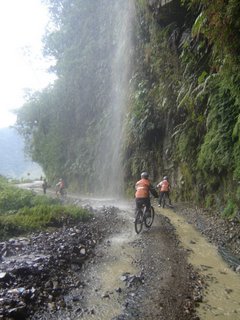
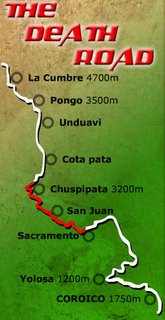
In Bolivia - South America in the department of La Paz there is an awesome road that takes you from the heights of the Andes to the jungles of the “Yungas” The road is called “DEATH ROAD” or “El Camino de la Muerte” – no kidding.

The road is used by cyclists throughout the world to test their vim. The ultimate thrill ride!
Check this out – here is my niece’s team going from the heights of La Paz (~13,000 feet) to the jungle, all on a one lane road……… amazing!

Click the picture below for the story board:

Congratulations to the team!


Other neat web links about the “Death Road” can be found at:


Friday, November 18, 2005

OPPORTUNITIES!

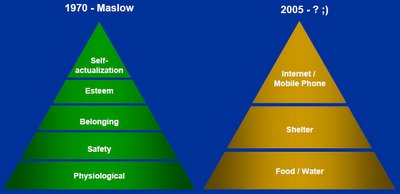
There is a presentation Mary Meeker of Morgan Stanley that is sobering! You just heard about the $100 computer… how else is industry looking at the upcoming changes in technology and its implications world wide?

You heard of Yahoo, Google, Skype, and others…?

You will be blown away if you check this out. The diagram is tongue-in-cheek but the implications are sobering!

This is really a word to the wise, isn't it?

Thursday, November 17, 2005

THE 100$ LAPTOP COMPUTER

Hear ye, hear ye! The $100 laptop is here! Computing for the world masses…!

Incredible advances in technology and the foresight of a visionary’s visionary: Nicholas Negroponte – the head of the MIT Media Lab, have brought about a new revolution. Keep an eye on this one – check out today’s Gizmodo:

What do you think?

There is something sad about this in some ways, many teachers do not use computer technology, no matter how accessible; in fact, they are afraid of this tool… if it is $100 or $10,000 it doesn’t make much difference to them. Unless a teacher finds value in the tool by himself or herself they will not use anything new. Their lack of vision hurts the students and themselves.

Those that will pick up the tools of the future are those that fulfill a key trait of highly effective teachers:

Openness to and enthusiasm for learning: can engage with a variety of educational ideas with an open mind and a sense of exploration; demonstrates passion for and metacognition of learning across the curriculum and within discipline areas; takes advantage of learning opportunities and seeks out additional opportunities for learning.

Here is a key links related to this topic:

Herald Tribune

Saturday, November 12, 2005

WHAT IS TEACHING?


What is teaching?

Is teaching the process of knowledge transfer between “master” and pupil?

We can first ask what is knowledge? Have you thought about it? How can you recognize it in yourself and in others? What does it mean to “know?”

The thesaurus diagram above helps a bit…look at the groupings for the word “know,” To know or to have knowledge of something means that you, 1) can recall/recollect/retrieve information, 2) understand, 3) are experienced, 4) are able to discern and differentiate, 5) are able to recognize and be aware. So if our students really know something – they are truly empowered!

But how do they “get it”? How do they get this “know”?

The pedagogical term cognition can help shed some light into this knowledge business. Cognition means to come to know (from the Latin cognoscere) You will notice how close the word is to “conocer” in Spanish which means: to know. So cognition is the outcome – it is the result of perception, and learning, and reasoning.

Well, is a teacher’s job then to pass on his or her knowledge to the student? This would be something akin to pouring facts and figures into a student’s head. Sure sounds like it would be easy but very boring! But is that how students learn to “know?”

Another term that might help shed light is metacognition. The prefix “meta” just means: about, higher or beyond. This is really the key for teachers.

Metacognition is the in-built skill of an explicit and conscious learning self-awareness; how one processes input through our senses, how one processes the information, how one makes connections with one’s own prior knowledge, how one gains and stores new insights, how one recognizes noise or deficiencies in one’s understanding and how one applies techniques to correct them. Doty, et. al. in Teaching Reading in Social Studies for example say, “Effective readers who have learned metacognitive skills can plan and monitor their comprehension, adapting and modifying their reading accordingly. Struggling readers need to be taught how to monitor their thinking as they read and how to select appropriate strategies to help them when needed.”

So what is a teacher supposed to do - really? If metacognition is student’s internal process of a learning self-awareness what is the teacher’s role? To enable the process of course!

I love the succinct teaching of Dr. Howard Hendricks, he says, “the way people learn determines how you teach” Wow – how simple and direct.

He says,

Teach students how to think

Teach people how to learn

Teach people how to work

The teacher must be a motivator; and the learner is primarily an investigator, a discoverer, and a doer. Teach to THINK, LEARN & WORK by helping students master:

Reading

Writing

Listening

Speaking

What is your take?

Thursday, November 10, 2005

SE HACE CAMINOS AL ANDAR

This saying, "Se hace caminos al andar" translates literally to “Roads are made by walking.” But the rich meaning of the words in Spanish of course imply more than the literal translation. The saying means that when you walk, take action, move in a direction you trail blaze, you open new roads, you move forward – it is a poetic observation of life. I have been running into this saying several times this semester. First I encountered in my BCLAD class with Juan Necochea – his sister sang the melody at the pedagogical conference earlier in the semester - beautiful. I also encountered a great blog with the same name in New York by Nani.

Where does the saying come from? I am sure most Hispanics know but I admit that I did not. So I did a bit of research and found that was written by Antonio Machado (1875-1939). Machado is the accomplished Spanish poet a close friend of Ruben Dario who wrote:

Cantares...
Todo pasa y todo queda,
pero lo nuestro es pasar,
pasar haciendo caminos,
caminos sobre el mar.

Nunca persequí la gloria,
ni dejar en la memoria
de los hombres mi canción;
yo amo los mundos sutiles,
ingrávidos y gentiles,
como pompas de jabón.

Me gusta verlos pintarse
de sol y grana, volar
bajo el cielo azul, temblar
súbitamente y quebrarse...

Nunca perseguí la gloria.

Caminante, son tus huellas
el camino y nada más;
caminante, no hay camino,
se hace camino al andar.

Al andar se hace camino
y al volver la vista atrás
se ve la senda que nunca
se ha de volver a pisar.

Caminante no hay camino
sino estelas en la mar...

Hace algún tiempo en ese lugar
donde hoy los bosques se visten de espinos
se oyó la voz de un poeta gritar
"Caminante no hay camino,
se hace camino al andar..."

Golpe a golpe, verso a verso...

Murió el poeta lejos del hogar.
Le cubre el polvo de un país
vecino.
Al alejarse le vieron llorar.
"Caminante no hay camino,
se hace camino al andar..."

Golpe a golpe, verso a verso...

Cuando el jilguero no puede cantar.
Cuando el poeta es un peregrino,
cuando de nada nos sirve rezar.
"Caminante no hay camino,
se hace camino al andar..."

Golpe a golpe, verso a verso.

The CD Cantares by Rosalia Necochea is beutiful, click on the image below to hear a snippet of the song:
Contact her at (951)312-8706 if you wish to order the CD.

Wednesday, November 09, 2005

THINK

While covering the subject of writing in our literacy class we discussed our selective reading of William Zinsser’s book, Writing to Learn. This is the paragraph that highlighted for me an important observation:

“Back when some of us were concerned about why Johnny can’t write,” Professor McRostie told me, “a psychologists put it to us that Johnny can’t reason, and I’ve been preoccupied with that thought ever since. The first two books I assigned last term were, the Art of Thinking, by Vincent Ruggiero, and Reasoning, by Michael Scriven. This is the generation that has spent fifteen thousand hours watching television, and its attention span is short. I’m challenging my students to find their powers of reasoning.”

I mentioned to my peers that we no longer seem to have time to really think things through… we are all so busy just tasking like the proverbial squirrel. It made me think that it is a societal issue, isn’t? The magazine Darwin (darwinmagazine.com) has an article titled: “The Value of Thinking” with a subtitle: Ideas are not in short supply. But thinking them through is not valued enough. They recommend that managers should encourage their people to:
  • Talk about the need to think
  • Invite people to think
  • Learn from thinking
As teachers we ought to do the same of course, but the whole thing reminded me of the wisdom of the past. If you are a history buff (which I am) and a computer aficionado (which I am) do you remember who else actually had embedded into their corporate culture the motto: “think”? Do you remember the company?

Well it was brought over from a company called National Cash Register (NCR) back in 1914 to a new company called Computer-Tabulating-Recording-Company by Thomas J. Watson. That company was the forerunner of today’s IBM.

Do you think it is an accident that they named their laptop computers: IBM Think Pad?

And now you know the rest of the story….

Friday, November 04, 2005

HISTORY IN THE MAKING

“History in the making….” have you heard that expression? Of course, everyone has; the trouble is what if you miss it? What if history passed you by? It always becomes harder to recover it; doesn’t it? Primary sources are gone, people’s memories fade – you get the picture…or not!

Take for example Rosa Parks – one of the icons of the Civil Rights movement. She passed away this past month – and the country mourned her. Will new generations know and remember her? I hope so. It is up to us history teachers to keep her contributions vibrant and in perspective – we should make sure Americans never forget. May she rest in peace – heaven and earth are richer places because of her.

On a lighter note… I occasionally come across some great discoveries – of all places at garage sales! (Honestly – I hate shopping, but I break for used books and old items of interest). In any case, I picked up a box full of old “78” records a while back for I think a few dollars. Well I did not know I hit the jackpot! I have literally over 100 old records some dating all the way back to the early 1900s! And the music? – all kinds, from country to jazz, to blues, to classical. And the labels? – you name it: Odeon, Capitol, Okeh. Decca, Victor, etc. How about the artists? – Bing Crosby, Gene Autry, “Fats” Waller (Jazz), even Caruso – yes THE Caruso. Here is one example:


This is a first recording of Gene Autry’s signature song: “Back in the Saddle Again” I would have never thought I would own it! Pretty cool – huh? Then you start thinking about it – this would make a great lesson for the kids… This recording dates back to 1939 – just before World War II. A technique to trace history is to look at the life of one individual, so why not Gene Autry? You can learn a lot! Who was Gene Autry prior to 1939? What did he do after 1939? What was Texas, Oklahoma and California like when he lived there? How did it change during WWII? What did Gene Autry contribute to the war effort? You can even introduce some fun stuff like - can you trace “Back in the Saddle Again” in a new movie? (Sleepless in Seattle) Why was this particular record selected – was it important, why?

Great possibilities you have to admit – you can also engage the kids in the history of technology 10” 78 RPMs vs today’s CDs and podcasting. You can even create a project to “clean” up the sound of a 78 – and digitize it to a CD as a way of preserving history. Well – ? Yeah, it would work. Of course you would need one of these…


And yes – this record player has four speeds: 16, 33, 45, 78 RPMs– I bet most of you have never heard of a 16 rpm record?

Tuesday, November 01, 2005

CALQUE

As you know I am a fan of Visual Thesaurus – today they had a take on how foreign expressions get integrated into the language – the word is CALQUE (pronounced “caalk”). Calque means: an expression introduced into one language by translating it from another language.

Calque sounds like the Spanish word “calcar” – which means to trace over, to delineate or copy something. Anyway, here are some calques – enjoy!

Blue Blood from the Spanish: Sangre Azul
Potpourri form the Spanish: Olla Podrida (Rotten Pot)
Chop chop from the Chinese: Quick Quick
Flea market
from French: marché aux puces

Can you think of others?

Sunday, October 30, 2005

TESTING IN 1895

Think about 8th grade.... this is the kind of test they had to pass in 1895:

U.S. History (Time, 45 minutes) - 8th Grade
  1. Give the epochs into which U.S. History is divided.
  2. Give an account of the discovery of America by Columbus.
  3. Relate the causes and results of the Revolutionary War.
  4. Show the territorial growth of the United States.
  5. Tell what you can of the history of Kansas.
  6. Describe three of the most prominent battles of the Rebellion.
  7. Who were the following: Morse, Whitney, Fulton, Bell, Lincoln, Penn, and Howe?
  8. Name events connected with the following dates: 1607, 1620, 1800, 1849, and 1865?

What do you think if you had to take such a test? How would you do? If you have or are teaching kids, how would they do - no matter what grade they are in?

Check out the test on other subjects at Grandfather Education Report.

Saturday, October 29, 2005

INTO – HISTORY

I got this link courtesy of my niece in Bolivia – it got me thinking… not all appears as is – does it?
How about using this as an “into” for presenting and introducing the interpretation of historical primary sources? The need to be careful how to interpret evidence… What do you think – or better yet, what do you see? Pink balls?
Check the link and really find out:


ENGLISH LANGUAGE LEARNERS

It was ironic that I was visiting a Vista High School US History class being taught exclusively in Spanish. After class I picked up the North County Times which carried this editorial headline:


If I understand this correctly, classes such as the one I was observing next year will be history (no pun intended). The emphasis will be English immersion. Good or Bad? Depends who you ask – it is a red-hot debate, it is sacred ground – it is a solipsistic issue with two disputing bands of professionals as its core – each with their own special pedagogical and political interests at heart.

In 1998 California passed Proposition 227 which did away with bilingual education. It is now 2005 – so what does this mean to teachers; to me? It means we have to be much more cognitive of what English Language Learners (ELL) students truly require – in theory and practice. We must be much more pro-active and sensitive to assess literacy levels and work to scaffold the students to be successful in the classes we teach all the while insuring that not only ELL students progress but that all students have the same support to excel in school. A challenge – you bet! Doable? No doubt.

Saturday, October 22, 2005

Having sat through so many classes in the last few years a the university level and having likewise participated in many hours of observations at middle school, and high school – I am amazed at how bad the ergonomics and equipment facilities are in our classrooms. If you take a cursory look at what the Corporate world does for their people to insure productivity and good will – it is amazing what the schools are lacking.

If these facilities are available for knowledge workers – what about for classrooms designed to serve teachers and students where they need flexible configurations, group work and an attractive ambiance. Dreaming?

Well actually I was not disappointed to find out that there is such an animal! At least it exists – which I find encouraging….. don't you? Here are some pictures and a link in case you are interested.

Check it out at:

Now how do we get these into our classrooms?