Friday, November 18, 2005

OPPORTUNITIES!

There is a presentation Mary Meeker of Morgan Stanley that is sobering! You just heard about the $100 computer… how else is industry looking at the upcoming changes in technology and its implications world wide?

You heard of Yahoo, Google, Skype, and others…?

You will be blown away if you check this out. The diagram is tongue-in-cheek but the implications are sobering!
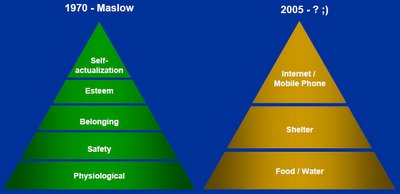
This is really a word to the wise, isn't it?

Thursday, November 17, 2005

THE 100$ LAPTOP COMPUTER

Hear ye, hear ye! The $100 laptop is here! Computing for the world masses…!

Incredible advances in technology and the foresight of a visionary’s visionary: Nicholas Negroponte – the head of the MIT Media Lab, have brought about a new revolution. Keep an eye on this one – check out today’s Gizmodo:

What do you think?

There is something sad about this in some ways, many teachers do not use computer technology, no matter how accessible; in fact, they are afraid of this tool… if it is $100 or $10,000 it doesn’t make much difference to them. Unless a teacher finds value in the tool by himself or herself they will not use anything new. Their lack of vision hurts the students and themselves.

Those that will pick up the tools of the future are those that fulfill a key trait of highly effective teachers:

Openness to and enthusiasm for learning: can engage with a variety of educational ideas with an open mind and a sense of exploration; demonstrates passion for and metacognition of learning across the curriculum and within discipline areas; takes advantage of learning opportunities and seeks out additional opportunities for learning.

Here is a key links related to this topic:

Herald Tribune

Saturday, November 12, 2005

WHAT IS TEACHING?


What is teaching?

Is teaching the process of knowledge transfer between “master” and pupil?

We can first ask what is knowledge? Have you thought about it? How can you recognize it in yourself and in others? What does it mean to “know?”

The thesaurus diagram above helps a bit…look at the groupings for the word “know,” To know or to have knowledge of something means that you, 1) can recall/recollect/retrieve information, 2) understand, 3) are experienced, 4) are able to discern and differentiate, 5) are able to recognize and be aware. So if our students really know something – they are truly empowered!

But how do they “get it”? How do they get this “know”?

The pedagogical term cognition can help shed some light into this knowledge business. Cognition means to come to know (from the Latin cognoscere) You will notice how close the word is to “conocer” in Spanish which means: to know. So cognition is the outcome – it is the result of perception, and learning, and reasoning.

Well, is a teacher’s job then to pass on his or her knowledge to the student? This would be something akin to pouring facts and figures into a student’s head. Sure sounds like it would be easy but very boring! But is that how students learn to “know?”

Another term that might help shed light is metacognition. The prefix “meta” just means: about, higher or beyond. This is really the key for teachers.

Metacognition is the in-built skill of an explicit and conscious learning self-awareness; how one processes input through our senses, how one processes the information, how one makes connections with one’s own prior knowledge, how one gains and stores new insights, how one recognizes noise or deficiencies in one’s understanding and how one applies techniques to correct them. Doty, et. al. in Teaching Reading in Social Studies for example say, “Effective readers who have learned metacognitive skills can plan and monitor their comprehension, adapting and modifying their reading accordingly. Struggling readers need to be taught how to monitor their thinking as they read and how to select appropriate strategies to help them when needed.”

So what is a teacher supposed to do - really? If metacognition is student’s internal process of a learning self-awareness what is the teacher’s role? To enable the process of course!

I love the succinct teaching of Dr. Howard Hendricks, he says, “the way people learn determines how you teach” Wow – how simple and direct.

He says,

Teach students how to think

Teach people how to learn

Teach people how to work

The teacher must be a motivator; and the learner is primarily an investigator, a discoverer, and a doer. Teach to THINK, LEARN & WORK by helping students master:

Reading

Writing

Listening

Speaking

What is your take?
Thursday, November 10, 2005

SE HACE CAMINOS AL ANDAR

This saying, "Se hace caminos al andar" translates literally to “Roads are made by walking.” But the rich meaning of the words in Spanish of course imply more than the literal translation. The saying means that when you walk, take action, move in a direction you trail blaze, you open new roads, you move forward – it is a poetic observation of life. I have been running into this saying several times this semester. First I encountered in my BCLAD class with Juan Necochea – his sister sang the melody at the pedagogical conference earlier in the semester - beautiful. I also encountered a great blog with the same name in New York by Nani.

Where does the saying come from? I am sure most Hispanics know but I admit that I did not. So I did a bit of research and found that was written by Antonio Machado (1875-1939). Machado is the accomplished Spanish poet a close friend of Ruben Dario who wrote:

Cantares...
Todo pasa y todo queda,
pero lo nuestro es pasar,
pasar haciendo caminos,
caminos sobre el mar.

Nunca persequí la gloria,
ni dejar en la memoria
de los hombres mi canción;
yo amo los mundos sutiles,
ingrávidos y gentiles,
como pompas de jabón.

Me gusta verlos pintarse
de sol y grana, volar
bajo el cielo azul, temblar
súbitamente y quebrarse...

Nunca perseguí la gloria.

Caminante, son tus huellas
el camino y nada más;
caminante, no hay camino,
se hace camino al andar.

Al andar se hace camino
y al volver la vista atrás
se ve la senda que nunca
se ha de volver a pisar.

Caminante no hay camino
sino estelas en la mar...

Hace algún tiempo en ese lugar
donde hoy los bosques se visten de espinos
se oyó la voz de un poeta gritar
"Caminante no hay camino,
se hace camino al andar..."

Golpe a golpe, verso a verso...

Murió el poeta lejos del hogar.
Le cubre el polvo de un país
vecino.
Al alejarse le vieron llorar.
"Caminante no hay camino,
se hace camino al andar..."

Golpe a golpe, verso a verso...

Cuando el jilguero no puede cantar.
Cuando el poeta es un peregrino,
cuando de nada nos sirve rezar.
"Caminante no hay camino,
se hace camino al andar..."

Golpe a golpe, verso a verso.

The CD Cantares by Rosalia Necochea is beutiful, click on the image below to hear a snippet of the song:
Contact her at (951)312-8706 if you wish to order the CD.

Wednesday, November 09, 2005

THINK

While covering the subject of writing in our literacy class we discussed our selective reading of William Zinsser’s book, Writing to Learn. This is the paragraph that highlighted for me an important observation:

“Back when some of us were concerned about why Johnny can’t write,” Professor McRostie told me, “a psychologists put it to us that Johnny can’t reason, and I’ve been preoccupied with that thought ever since. The first two books I assigned last term were, the Art of Thinking, by Vincent Ruggiero, and Reasoning, by Michael Scriven. This is the generation that has spent fifteen thousand hours watching television, and its attention span is short. I’m challenging my students to find their powers of reasoning.”

I mentioned to my peers that we no longer seem to have time to really think things through… we are all so busy just tasking like the proverbial squirrel. It made me think that it is a societal issue, isn’t? The magazine Darwin (darwinmagazine.com) has an article titled: “The Value of Thinking” with a subtitle: Ideas are not in short supply. But thinking them through is not valued enough. They recommend that managers should encourage their people to:
  • Talk about the need to think
  • Invite people to think
  • Learn from thinking
As teachers we ought to do the same of course, but the whole thing reminded me of the wisdom of the past. If you are a history buff (which I am) and a computer aficionado (which I am) do you remember who else actually had embedded into their corporate culture the motto: “think”? Do you remember the company?

Well it was brought over from a company called National Cash Register (NCR) back in 1914 to a new company called Computer-Tabulating-Recording-Company by Thomas J. Watson. That company was the forerunner of today’s IBM.

Do you think it is an accident that they named their laptop computers: IBM Think Pad?

And now you know the rest of the story….

Friday, November 04, 2005

HISTORY IN THE MAKING

“History in the making….” have you heard that expression? Of course, everyone has; the trouble is what if you miss it? What if history passed you by? It always becomes harder to recover it; doesn’t it? Primary sources are gone, people’s memories fade – you get the picture…or not!

Take for example Rosa Parks – one of the icons of the Civil Rights movement. She passed away this past month – and the country mourned her. Will new generations know and remember her? I hope so. It is up to us history teachers to keep her contributions vibrant and in perspective – we should make sure Americans never forget. May she rest in peace – heaven and earth are richer places because of her.

On a lighter note… I occasionally come across some great discoveries – of all places at garage sales! (Honestly – I hate shopping, but I break for used books and old items of interest). In any case, I picked up a box full of old “78” records a while back for I think a few dollars. Well I did not know I hit the jackpot! I have literally over 100 old records some dating all the way back to the early 1900s! And the music? – all kinds, from country to jazz, to blues, to classical. And the labels? – you name it: Odeon, Capitol, Okeh. Decca, Victor, etc. How about the artists? – Bing Crosby, Gene Autry, “Fats” Waller (Jazz), even Caruso – yes THE Caruso. Here is one example:


This is a first recording of Gene Autry’s signature song: “Back in the Saddle Again” I would have never thought I would own it! Pretty cool – huh? Then you start thinking about it – this would make a great lesson for the kids… This recording dates back to 1939 – just before World War II. A technique to trace history is to look at the life of one individual, so why not Gene Autry? You can learn a lot! Who was Gene Autry prior to 1939? What did he do after 1939? What was Texas, Oklahoma and California like when he lived there? How did it change during WWII? What did Gene Autry contribute to the war effort? You can even introduce some fun stuff like - can you trace “Back in the Saddle Again” in a new movie? (Sleepless in Seattle) Why was this particular record selected – was it important, why?

Great possibilities you have to admit – you can also engage the kids in the history of technology 10” 78 RPMs vs today’s CDs and podcasting. You can even create a project to “clean” up the sound of a 78 – and digitize it to a CD as a way of preserving history. Well – ? Yeah, it would work. Of course you would need one of these…


And yes – this record player has four speeds: 16, 33, 45, 78 RPMs– I bet most of you have never heard of a 16 rpm record?

Tuesday, November 01, 2005

CALQUE

As you know I am a fan of Visual Thesaurus – today they had a take on how foreign expressions get integrated into the language – the word is CALQUE (pronounced “caalk”). Calque means: an expression introduced into one language by translating it from another language.

Calque sounds like the Spanish word “calcar” – which means to trace over, to delineate or copy something. Anyway, here are some calques – enjoy!

Blue Blood from the Spanish: Sangre Azul
Potpourri form the Spanish: Olla Podrida (Rotten Pot)
Chop chop from the Chinese: Quick Quick
Flea market
from French: marché aux puces

Can you think of others?

Sunday, October 30, 2005

TESTING IN 1895

Think about 8th grade.... this is the kind of test they had to pass in 1895:

U.S. History (Time, 45 minutes) - 8th Grade
  1. Give the epochs into which U.S. History is divided.
  2. Give an account of the discovery of America by Columbus.
  3. Relate the causes and results of the Revolutionary War.
  4. Show the territorial growth of the United States.
  5. Tell what you can of the history of Kansas.
  6. Describe three of the most prominent battles of the Rebellion.
  7. Who were the following: Morse, Whitney, Fulton, Bell, Lincoln, Penn, and Howe?
  8. Name events connected with the following dates: 1607, 1620, 1800, 1849, and 1865?

What do you think if you had to take such a test? How would you do? If you have or are teaching kids, how would they do - no matter what grade they are in?

Check out the test on other subjects at Grandfather Education Report.

Saturday, October 29, 2005

INTO – HISTORY

I got this link courtesy of my niece in Bolivia – it got me thinking… not all appears as is – does it?
How about using this as an “into” for presenting and introducing the interpretation of historical primary sources? The need to be careful how to interpret evidence… What do you think – or better yet, what do you see? Pink balls?
Check the link and really find out:


ENGLISH LANGUAGE LEARNERS

It was ironic that I was visiting a Vista High School US History class being taught exclusively in Spanish. After class I picked up the North County Times which carried this editorial headline:


If I understand this correctly, classes such as the one I was observing next year will be history (no pun intended). The emphasis will be English immersion. Good or Bad? Depends who you ask – it is a red-hot debate, it is sacred ground – it is a solipsistic issue with two disputing bands of professionals as its core – each with their own special pedagogical and political interests at heart.

In 1998 California passed Proposition 227 which did away with bilingual education. It is now 2005 – so what does this mean to teachers; to me? It means we have to be much more cognitive of what English Language Learners (ELL) students truly require – in theory and practice. We must be much more pro-active and sensitive to assess literacy levels and work to scaffold the students to be successful in the classes we teach all the while insuring that not only ELL students progress but that all students have the same support to excel in school. A challenge – you bet! Doable? No doubt.

Saturday, October 22, 2005

Having sat through so many classes in the last few years a the university level and having likewise participated in many hours of observations at middle school, and high school – I am amazed at how bad the ergonomics and equipment facilities are in our classrooms. If you take a cursory look at what the Corporate world does for their people to insure productivity and good will – it is amazing what the schools are lacking.

If these facilities are available for knowledge workers – what about for classrooms designed to serve teachers and students where they need flexible configurations, group work and an attractive ambiance. Dreaming?

Well actually I was not disappointed to find out that there is such an animal! At least it exists – which I find encouraging….. don't you? Here are some pictures and a link in case you are interested.

Check it out at:

Now how do we get these into our classrooms?

Sunday, October 16, 2005

FOUND POEM

Well, a new strategy to be used in teaching is the Found Poem. It is an interesting concept... you take significant words or phrases from any text and arrange them to give them a new meaning. Why? Well it allows students to think abou the words or phrases, it allows them to manipulate text, meaning, and hopefully increase understanding while having fun with words.

The one listed in Wikippedia as many people attributed the speeches of Donal Rumsfeld as found poetry - this is worth noting: :)

The Unknown
As we know,
There are known knowns.
There are things we know we know.
We also know
There are known unknowns.
That is to say
We know there are some things
We do not know.
But there are also unknown unknowns,
The ones we don't know
We don't know.

Donald Rumsfeld, Feb. 12, 2002, Department of Defense news briefing
Checkout the Wikipedia link!

LEARNING STRATEGIES DATABASE

Sometimes – assignments lead to gold strikes!

As we struggle in our literacy class to understand the complexities of teaching literacy in addition to learning the taste of a new alphabet soup: QAR, SQ3R, SQ4R, SQRQCQ, CARI, etc. it is nice to stumble on a rich discovery.

Muskingum University has a web site called “Center for Advanced Learning” that has a Learning Strategies Database. Precious!

The data base gives a comprehensive list of strategies for students, parents, teachers, and High School counselors covering a multitude of topics with absolutely great and detailed stragegies that can be followed. For example, note taking, information organization, reading and memory strategies, test preparation and test taking strategies, very impressive. Click on the image below to explore:


This link came from another great web site called: Literacy Matters - looks like another gold mine to explore!

Thursday, October 13, 2005

PLAYING WITH WORDS

Well I had an interesting exchange with a British colleague I wanted to share... I sent her an e-mail that read:


I was referring to have her check some links in relation to our project. Well – you know about words – she responded with:

Her response tickled me and I realized that she probably was not too familiar with the term: “Take a gander.” But her response was funny – typically British! In any case I sent her this link which helped enlighten us both:

Her response after checking it out, was:

Curious? Check it out - go on, take a gander!

Wednesday, October 05, 2005

GEODESIC DOME - MATH IN ACTION!


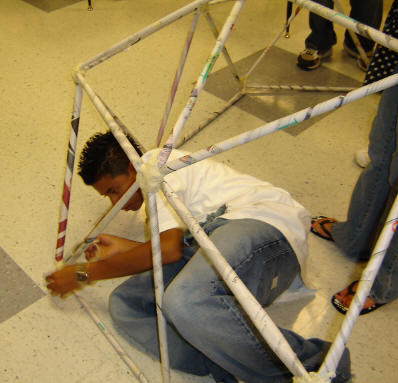
Multiple intelligences in action! Look at these bright students as they assemble a paper geodesic dome - and learn: history, geometry, math, architecture, material strength, structural strength etc. Great practical examples for our future engineers, historians, and doctors! Courtesy of Lewisville High School. This is an example of great teaching!

Monday, September 26, 2005

TEACHERS AS TARGETS

There is an International Herald Tribune article that is chilling - teachers are now being targeted in Iraq. Why teachers? Why not! Teachers are dangerous... remember the poignant poem Pat Stall read to us last summer?

The poem is by Sigmund A. Boloz and is called "Be Dangerous" ; near the end it reads:

"...but because this is America, you must continue to be a teacher
You, the teacher, are freedom's greatest hope... be dangerous."

BORDER PEDAGOCY - PEDAGOGIA FRONTERIZA

We were priviledged to attend the "Crossing Borders: Education for a New World", in Spanish, "Cruzando Fronteras: Educación para un mundo nuevo" on Saturday September 24th. It was a great experience to meet the teachers from Tijuana and San Diego under one roof. The event was punctuated with a great mexican breakfas, and a nice lunch - including "flan!" for those of us with a sweet tooth - and of course music!

The brass was in town that morning - got to see the president of the University Karen Haynes along with the head of the College of Education Mark Baldwin plus all the key figures of the COE that are involved in languages, Juan, Zee, John, Maria de la luz, Elizabeth, and others.

These are a few of the pictures:


Check out some more pictures posted at FLICKR:

http://www.flickr.com/photos/37257426@N00/

If you have any questions please drop me a note...

TECHNOLOGY

Computer-Using Educators - are you a member? If you have taken Educ 422 you probably are a member of CUE. This is just to let you know that there is a local conference coming up in October...

Check it out:


Things you will learn: Digital Imaging with Ease - curriculum integration, Virtual Gaming, Podcasting 101, Wikis for Wackos: Cross-curriculum & Differentiated instruction...and much much more...

Monday, September 19, 2005

BILINGUAL - EDUCATION - MULTICULTURALISM

As a teacher-in-training you will be exposed to dogmas and philosophical beliefs and many hot-button societal issues. Familiarize yourself in a rounded fashion on things like: Bilingual Education, Multiculturalism, Race, Fairness, etc. Be prepared to think things through - as an individual, as an American citizen, and as a teacher. As a teacher you have the responsibility to strengthen the fabric of our nation As MLK so elegantly said:

I have a dream that one day this nation will rise up and live out the true meaning of its creed, 'We hold these truths to be self-evident, that all men are created equal.' I have a dream that one day on the red hills of Georgia, sons of former slaves and the sons of former slave owners will be able to sit down together at the table of brotherhood...I have a dream that my four little children will one day live in a nation where they will not be judged by the color of their skin, but by the content of their character. Speech at the Lincoln Memorial, 1963.

Thursday, September 08, 2005

WHY?

I have been asked so many times... why do you want to become a High School teacher and leave a very nicely paid career? Well my answer has always been - while I still have the energy - I would like to share my knowledge, experience and help builld up young people... honeslty to try to make a difference that is more lasting than the Corporate world - so on I pursue my credentials. Dreamer? Perhaps - but I have to be true to myself... we shall see.

In any case, there is a great write up at Star Tribune by Katherin Kersten - check it out. She concludes with:

"If you want to influence our nation for the good, the most important thing you can do is become a high school teacher."

Wednesday, September 07, 2005

FOLKSONOMY

Have you ever used "Favorites" in your web browser? It helps you organize your PC links nicely and to your liking. There is also in Yahoo something called Yahoo Bookmarks which allows you to do the same thing except your favorites become available on ANY computer.

Well, there is another iteration that is even more powerfull called: del.icio.us this tool actually allows you to bookmark any page without any hassles and it allows you to extend the name and add tags! This very cool feature is called Folksonomy - similar to taxonomy. Pay attention you English majors lest your students zip right by you! The Wikipedia defines folksonomy as: a neologism for a practice of collaborative categorization using freely chosen keywords.

Got that? It is a community way or organizing links! It means that the group has already vetted and categorized much more information that you alone could ever do! Egalitarianism at its best!

Here is the link if you dare:

Monday, September 05, 2005

¿TOMAS CAFÉ, NO?

You know how I love words…. I encountered a letter to W. F. Buckley in the August 29th edition of National Review that I thought was a keeper. The letter said:

…I don’t remember ever encountering a grammatical construction such as, “Your imagination should be able to handle that, no?”
Why not end with “yes”? And what response indicates agreement or disagreement when ending the query in “yes” or “no”?

WFB answers:

….Very interesting, As in other matters in language, doing what comes naturally tends to be the thing to do. The negative is obviously called for in French (“Tu désires du café, non?”) and Spanish (“¿Tomas café, no?). If one were to expand the negative locution here, we’d have “You’re going to have coffee, aren’t you?” And there is the negative, poking its head. Aren’t you? – Are you not? The sentence you quote is constructed to suggest that the addressee’s imagination is (presumably) sufficient to cope with the problem; so that the indicated answer – if the imagination were insufficient – would be: No. A “yes” could be accomplished by a nod of the head, or – silence…

Wow – talk about brilliance in handling the language!

Check out NRO at:

BLACK BOARD JUNGLE

Well, well, well – one week behind us! The first week in class was interesting, provocative – and as usual confusing.

Monday went to class to find out that the class was not being held that day! Oy Bey! Three of us stood in class looking at each other wondering – ok… where is the rest of the class? Lack of communication was the explanation – oh well. Class does not start until September 12th.

Tuesday was a-ok but boy you better keep up with the multitude of assignment/locations/explanations/suggestions in a conundrum of icons on the web… take out a wet suit and your scuba gear!

Wednesday – the syllabus said that class was held last week already! So some of us ended up going in as if we had missed a class already! It was a relief to find out it was a professor error! Now this class is very interesting – found another Bolivian in the class!! LOL J

Thursday – another miscommunication – could not find the classroom – we finally figured it out!

I tell you, the COE is a constant basic training boot camp. It makes you wonder if this is all part of teacher training… is this preparing us to face the blackboard jungle? Remember that movie? "The Blackboard Jungle" or am I dating myself because most kids would not know what a blackboard is... anyway, risking dating myself; the movie was about an idealistic teacher on his first job!!!!!! Honestly, check it out:


Monday, August 29, 2005

EDSS 521 - Michelle

Hi - just wanted to give you a head's up to the the latest from Michelle on WebCT. There are instructions to be done before class. This is part of her announcement:


Her class meets on Tuesdays 5:30-8:30 Academic Hall 407

If you are in her class - see you later!

Thursday, August 25, 2005

Hat tip Paige:

"Attached is a transcript from a live chat on advice for first-year teachers. It's kind of long, but there are some good pieces of advice throughout."


Wednesday, August 24, 2005

MICROSOFT STUDENT 2006

Well Microsoft is at it again - this time with a new package: MS Student 2006. It is an interesting concept - I have not evaluated it yet, but it is released. Here is the link:

Again this is shared so you are aware of the tools out there - the calculator stuff looks powerful, but the rest I don't now - I like to say, "I'm from Missouri - show me!" This might be just a lot of hype.
Tuesday, August 23, 2005

VISUAL THESAURUS

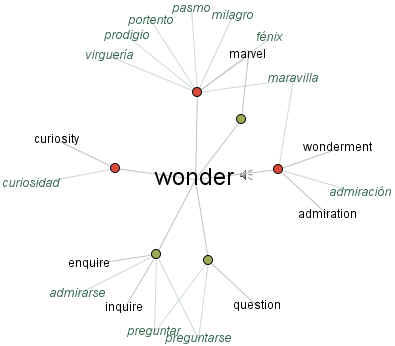
There are some programs that improve with age - like a good vintage wine. Visual Thesaurus is one of these jewels. Innovative in its design they have now added other languages, but not only other languages, it is how they implemented it! Very cool! This ought to prove a jewel for those in BCLAD classes, and actually English and language arts classes.

Here is an example - I looked at the word: "wonder" which is difficult to translate if you use it in the sentence: "I wonder...." The Spanish concepts of that sentence is tricky to translate but it is easier to do it with this picture:


Is that cool or what?

But not only that, you also get to hear the word pronounced (Listen you teachers that are teaching second language learners!) You can also e-mail this graphic to others if you wish, Then they have a "Teacher's Corner" to help teachers use the tool in their classrooms.

You can subscribe to the service or else buy the desktop version of the program - the cost is nominal really - two Frapuccinos' worth!

Here is the link:

Have a great time!

Thursday, August 18, 2005

WHAT DO STUDENTS THINK?

Check this out:

"A surprisingly high number of teenagers fear for their safety at school, believe teachers don't care about them and feel their classes lack demanding challenges, according to an Indiana University study to be released today"

Find the full article at: http://www.indystar.com/apps/pbcs.dll/article?AID=/20050817/NEWS01/508170483/1006/NEWS01

Tuesday, August 16, 2005

CSET III - PASSED!

One month later I got my notice via e-mail:

----------------------------------------------------------------------
Examination: 116 CSET Social Science Subtest III
Status: Pass
----------------------------------------------------------------------


Nice, very nice, all my testing is now complete: CBEST, CSET I, II, and III, BCLAD Oral & Written.

Today is also my wedding anniversary to boot! Time to celebrate - dinner at the Del is in order for my beautiful bride - don't you think?

Monday, August 15, 2005

KEVIN IGASAKI

Wow! What a shock to receive the e-mail from school about Kevin. He passed away last week.

It was incredible sad news. Dr. Kevin Igasaki was in charge of the Language Learning Center... it was but July 28th when he administered my BCLAD exam. He was a kind individual always supportive of the students - he will be missed I am sure.


We are lifting his family in prayer.

EDUCATION OUTSOURCING

I am not sure if you are aware of the trending within industry to outsource professional jobs out of the country - India in particular. They have a very well educated population with an powerful and extensive High School and University program that has created a tremendous workforce of engineers, system analysis, mathematicians, etc. That talent pool is hired by many companies because 1) it is cheaper and of higher quality, or 2) the talent is not available in the U. S. or is in short supply.

Well guess what? They are beginning to outsouce teaching jobs bacause of the shortage of math an science teachers.

"Close on the heels of their successful handling of Business Process Outsourcing and call centres, Indian firms will now provide private tuition facilities to British school children in mathematics and science over the internet. "

Check it out at the following link:

What do you think?

Friday, August 12, 2005

PURCHASING BOOKS

Well due to the great connections of a mathematician friend in the education business - he got my attention to the following site:

Best prices on books...! Check it out.

Friday, July 22, 2005

Words

I heard about a study conducted by Yale University where researchers found that of all the words in the dictionary, there are 12 with the power to positively impact people’s actions. These aren’t simply words; they are highly-persuasive tools that can be used to achieve beneficial results:

new
discover
save
guarantee
safety
results
proven
you
love
health
money
easy

I always believed that words have power - as new teachers perhaps we all can be cognizant of their value and most important of their influence! Interesting, don't you think?

Saturday, July 16, 2005

CSET SECTION III

Well… I just completed Section III of the CSET History exam! This section of the exam supposedly covered California history but … no, of course it didn’t; it was all over the map! The 40 multiple choice questions and three essays covered a range of topics most of which were general historical topics – few related to California – oh well!

Now let me think, in addition to your subject matter Bachelor’s or Master’s Degree you must take: EDUC 350 (3 units), EDUC 364 (3 units), EDUC 422 (3 units) in addition, you must provide a minimum of two letters of personal recommendation by a public school teacher to be accepted into the program, you also must pass: the CBEST test, the CSET Section I, Section II, and Section III tests for history, BCLAD Language Oral test, BCLAD Written test, the College Of Education Interview, the Cardio-Pulmonary Resuscitation (CPR) given by an authorized Red Cross provider , the FBI and Security Clearance as authorized by the State, a TB test, and finally you must submit your Records of Immunizations from the time you were born (no kidding!). Now you can continue your credentialing classes! Most of my cohort group is drooping like I am!

This whole affair feels like gigantic pasquinade being played on myself and my cohort group!

Help!

I am going out to dinner with my family to one of my favorite restaurants which I playfully call the “Road-kill” café........ I am gently chided by my wife and family NO! It is called the Roadhouse Grill as we rush out of the house because I envision a cold tall one waiting for me to go along with the a great steak - and peanuts on the floor! Salud!

Monday, July 11, 2005

VAIL HIGH SCHOOL - ALL ELECTRONIC

This very interesting article in says that Arizona’s Vail High School will not use textbooks – they will go completely to a wireless, laptop, network and NO textbooks… This is an interesting concept. Check out Vail High’s web site:


Monday, June 20, 2005

1/2 SUMMER IS OVER

Well, progress!

First, a collective sigh of relief by all the cohort for Summer 2005 as we finish the Keating's bootcamp! This was a lot of work… [caution future teachers] but overall, productive if you wish to be a jongleur !

Second, I just got news that CSET Section II on US History is now history – I passed!

Third, I got accepted into the BCLAD portion of the program…

Overall good progress…but the beat goes one – summer continues – next is EDSS 511 the remaining lectures and the masochistic time compression! Ayyyyyyyyyyyyyyyy

Hey – put it in perspective – this too will pass!


“¿No que no?”

Sunday, June 05, 2005

AND THE TIME KEEPS ROLLING BY!

Weeks are rolling by! May is over and we are chipping away at June. The cohort program now becomes a bit clearer (the fog has not totally lifted) but the team building is interesting as a paradigm to learn how to teach. By force we have had to intersect with others in the group, by force we have had to learn more about our styles and preferences, by force we are learning to know each other’s strengths and weaknesses, by force we are uniting as a team. I say by force because that is how you get through the class – but, interestingly enough the pressure to produce and perform as a group has “forced” us to be stressed beyond our comfort zone and things are getting done – and of relatively high quality… I think the paradigm is working…. I personally find the group work easier at times and at other times harder depending on partnering – which is natural…

There are some awesome incredibly creative people in our cohort….