

You don't know the border issues unless you understand the reality of the crossing - "...las cruces de los cruces."


Well – the next NECC is in San Antonio, Texas….yahoooo! Congratulations to ISTE for an incredible conference.


 The Technology Immersion Project is implementing an entirely new concept in educational technology—total immersion of teachers and students in technology. TIP steps beyond 1:1 computing experiments to completely envelope campuses in technology, extending learning beyond classroom walls and beyond the school day.
 FIFTH SESSION:
V E N D O R - S H O W
What an incredible display of products, colors, sounds, and “grab” gifts galore! I should be able to get my pen and pencil supplies for 2007-2008 without any problems! Should save us money… will make Jill and Varda happy ;)


 Andrew Zolli followed Dr. Davis. He was funny yet very enlightening in his message and his view of the future. Andrew is a futurist (a fancy term for a fortune teller! - just kidding Andrew…) and does well apparently: he is a founder of Z+Partners where he says that, “Ideas are the currency of the future” He emphasized that everything that can be done with a machine will! The question he then posed was, “so what are then humans supposed to do to add value?”
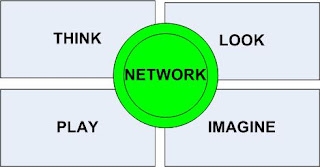
Where in the first box – we are asked to produce/desing/invent a product in an isolated “think” mode the failure rate is 85%. While in the “look” box where the person can go out and see what is required the failure rate is 30%. In the “play” box, the product/problem gets redefined but leads to only a 20% failure rate. “Imagine” does not apply because there is no product… (gotcha!) In any case, he went on to expand that the NETWORK model however is much more efficient and produces much less failure – it means that someone who can freely interchange within the four paradigms is more successful...
This to me is important, but it is also a bit of a "duh!" This really should be nothing new to historians... think back about brokerage and leverage and knowledge that can bring things together: treaties, agreements, large concessions, etc... it is always the networked guy that pulls it off!
 He gave another example of the value of networks: originally the value of networks were understood to be value = (# of notes)**2. He says the factor that is missing is participation – the true value is: value = (# of nodes)**”p” Where p=participation. The value is explosive when participation is attained!
He went onto illustrate the demographic transformation of the world and its implications – sobering actually. He outlined the factors of choice vs. complexity and also went on to redefine literacy – as a corollary of all the changes: how will we now “measure” literacy when the world’s knowledge is available on a device available to every student – give them a multiple choice-fill-in-the-bubble test?
He ended with an encouraging note to teachers to understand what is happening around them with themselves and understand their own Biases and Blindness and understand the futures we choose to bring our students.
Excellent keynote address.

The science behind the orchid exhibit, the "jungle" facilities, the Tissue Culture Lab, precious! After hundreds of digital images - it was probably still not enough... my Canon XTi was still craving for more! It is nice to have a 2 Gig memory card on the camera! :) Loved it!

And then Ella's birthday party!!! My grandbaby's first birthday!


The teacher then breaks this down into individual COMPETENCIES that the student will assess himself or herself against:
Do you see the value of this tool?
It would be a LOT of work with in my opinion well worth the effort to achieve excellence in teaching and student performance.





